
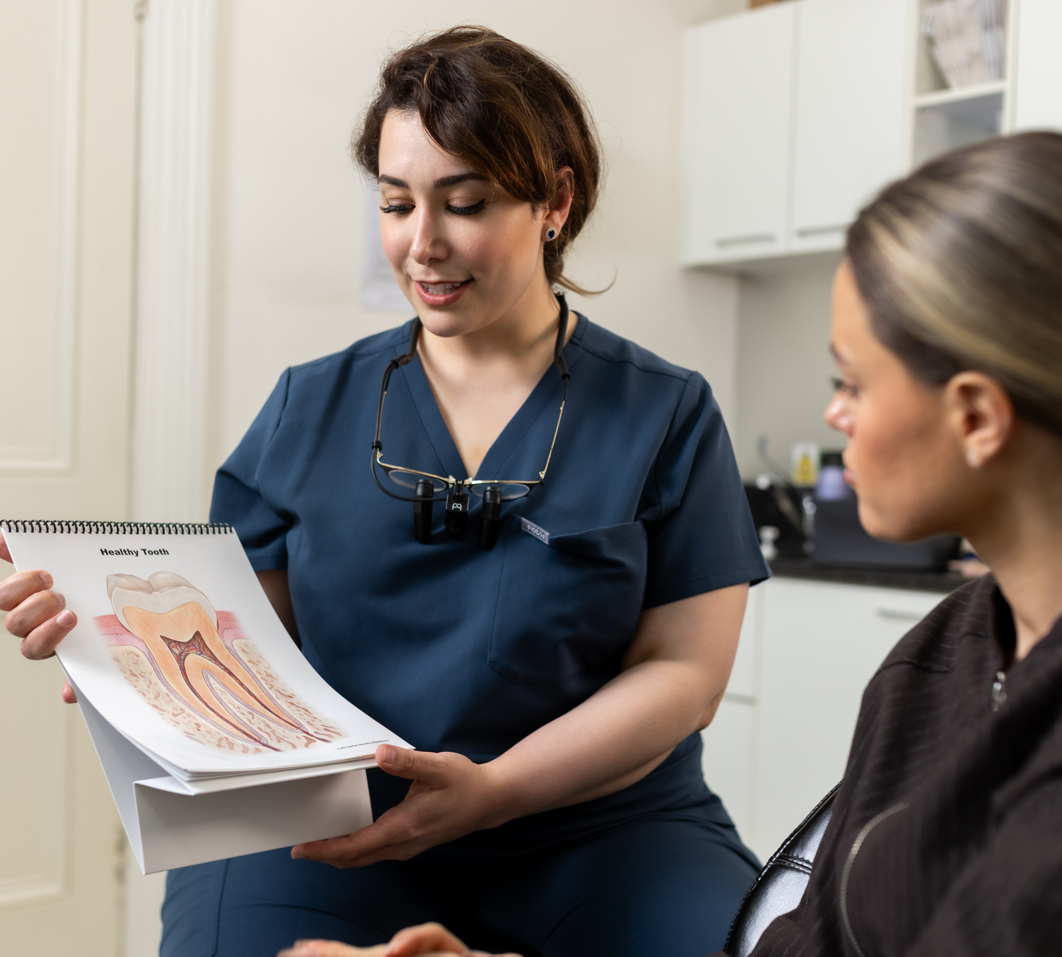
“Do you think I actually need treatment?”
It’s a question I’m asked surprisingly often. And sometimes, the answer is: no.
In fact, one of the things I think is important as a dentist is being comfortable telling someone that they don’t need treatment, even when there is something we could technically do.
Because just because something can be treated, doesn’t always mean that it should be treated.
Dentistry has come a long way. We have incredible materials, techniques and technology, and there are often lots of ways we can change the appearance or function of teeth.
But there is another side to good dentistry that is perhaps talked about less: knowing when to leave things alone.
Have you ever talked someone out of treatment?
Yes.
And I think that can sometimes be just as valuable as recommending treatment.
A patient recently came to see me because she was unhappy with the colour of one tooth.
The rest of her visible teeth had ceramic veneers, while this particular tooth was natural and healthy. Because it was a different shade, she felt it stood out and wanted to have a ceramic veneer placed on it so that it matched the others.
It would have been possible to do that.
But “possible” isn’t the same as “necessary”.
We talked through what placing a veneer would actually involve. Even though modern veneers can look fantastic, preparing a healthy natural tooth to accommodate one is still an irreversible step. It also introduces the ongoing maintenance that comes with any restoration. At some point in the future, it may need repairing or replacing.
So, I asked myself: is there a more conservative way of achieving what this patient actually wants?
There was.
Rather than altering the healthy tooth and placing a veneer, we discussed whitening it. It was simpler, less invasive and less costly. The patient was very happy with the result.
And I was happy too, because we had achieved what she wanted without unnecessarily altering a perfectly sound tooth.
That, to me, is a really good example of what conservative dentistry is about.
Sometimes the best treatment is the treatment that involves doing the least.
But “doing nothing” doesn’t really mean doing nothing
This is where I think the phrase can be misleading.
If I tell a patient, “I don’t think we need to treat that at the moment,” it doesn’t mean I’ve dismissed the problem or that I’m not taking it seriously.
It means we’ve considered it.
We’ve looked at the options, thought about the risks and benefits, considered what might happen if we intervene, and what might happen if we don’t, and decided that monitoring is the better course of action.
That is still a treatment decision.
Sometimes it involves taking photographs, X-rays or scans and comparing them over time. Sometimes it means reviewing the area at their next examination. Sometimes it means making small changes to habits or hygiene and seeing whether that is enough.
It’s not ignoring something. It’s keeping an eye on it without unnecessarily intervening.
There are lots of situations where less can be more.
For example, I might see someone with early tooth wear.
Perhaps they have some flattening or small areas of wear, but their teeth are comfortable, their bite is functioning well and there is no significant loss of tooth structure.
We could start rebuilding those teeth.
But do we need to?
If the situation is stable, sometimes the better approach is to understand why the wear is happening, make some preventive changes and monitor it.
Another example is an older filling.
A filling can look a little tired simply because it has been there for many years. That doesn’t automatically mean it needs replacing.
If it is functioning well, there is no decay around it and there isn’t a clinical reason to intervene, replacing it just because it is old could actually mean removing more healthy tooth structure.
Sometimes, the most conservative option is simply to keep an eye on it.
It’s a conscious decision not to intervene when the potential downsides of intervention aren’t justified by a clear benefit.
What about the patient who wants something done?
This can be one of the more difficult conversations.
Someone might come to you having already decided what treatment they want.
They may have researched it online. They may have seen someone else’s results. They may even have been told elsewhere that a particular treatment is what they need.
And as a dentist, it’s tempting to think that your job is to provide the treatment they have asked for.
But I think our responsibility is slightly different.
Our job is to understand what the patient is actually trying to achieve, and then work out the safest and most appropriate way of getting there.
Sometimes that means saying: “Let’s leave it for now and see how things change.”
That doesn’t mean saying no for the sake of saying no.
It means making sure the treatment is justified.
How do you decide whether something really needs treating?
There isn’t a single formula.
I think it comes down to looking at several things together.
Is there disease? Is it causing a problem? Is it getting worse? What happens if we leave it alone? And what are the consequences of treating it?
If leaving something alone carries a significant risk of deterioration, that changes the conversation.
But if monitoring it is unlikely to cause harm, observation may be perfectly reasonable.
And what are the consequences of treating it?
Every intervention has consequences.
Even something that seems relatively straightforward can involve removing healthy tooth tissue, introducing a restoration that will eventually need maintenance, or creating a cycle of treatment that didn’t need to start in the first place.
So sometimes the question isn’t simply:
“Can I treat this?”
It’s:
“Is the benefit of treating this greater than the cost and potential consequences of doing so?”
Sometimes I’ve changed a patient’s mind
And I don’t see that as persuading someone not to have dentistry.
I see it as helping them make an informed decision.
Someone might think an old filling need replacing when it is actually perfectly serviceable.
And sometimes, after explaining all the options, the patient still chooses treatment.
That’s absolutely fine.
The point isn’t to avoid treatment at all costs.
The point is that treatment should have a reason.
Dentistry isn’t always about fixing things
I think there can be a perception that a good dental appointment is one where something gets done.
A filling. A crown. An extraction.
But sometimes a successful appointment is one where the patient leaves with reassurance and a plan to monitor something.
Sometimes it’s an explanation.
Sometimes it’s prevention.
Sometimes it’s simply knowing that we don’t need to intervene today.
And sometimes the most valuable thing a dentist can say is:
“Let’s leave it alone for now.”
That doesn’t mean we don’t care.
It means we’ve looked at the bigger picture and decided that, for this particular patient, at this particular time, intervention isn’t necessary.
Because good dentistry isn’t about doing as much as possible.
It’s about doing what is appropriate.
And occasionally, the most appropriate treatment is no treatment at all.